The 3 Settings Every YouTube Channel Needs

Stop choosing between views and buyers
Hey,
This one is longer than usual because it is the full framework rather than a quick tip. Read it with your next four video ideas in front of you and you will finish knowing exactly what each one is for.
Business YouTubers are usually handed the same choice.
Chase bigger views and risk pulling in people who will never buy. Or stay so narrow that a few thousand of the right views feels like enough.
A few thousand of the right views can absolutely fill a high-ticket offer. But why settle for that if the same idea could have reached far more of the people you can help?
The goal is to get the maximum right views.
That includes people who can buy now, people who may buy later, and relevant viewers whose attention helps your video travel further through the market you want to own.
Some video ideas can appeal to a big part of your market. Others are useful to only a small group. If you ignore that difference, you can make helpful videos that never give your channel room to grow.
That's why I use a simple mental model.
The TAM Dial.
TAM means total addressable market. In plain English, how many people could credibly care about this video?
You can set the dial to three positions.
1. Depth
These videos solve a narrow, specific problem for people who already understand the subject.
A fitness channel might make “How to Fix Your Deadlift Lockout”. On my channel it might be how to read your advanced analytics properly.
The audience is smaller, but the problem is precise and the viewer is usually closer to taking action.
2. Core
These videos solve a problem that a large part of your ideal audience already recognises.
That same fitness channel's Core video might be “How to Build Muscle in Your 40s”. Mine might be how to write titles people actually click.
These usually make up the centre of a strong education channel. They are specific enough that the right person feels understood, but broad enough that the video has room to grow.
3. Wider
These videos open the door to more of the market. They might speak to beginners, problem-unaware viewers, or people who have the early version of the problem you eventually solve.
That fitness channel's Wider video might be “Why You're Not Losing Fat Even Though You're Doing Everything Right”. Mine might be how to get started on YouTube in 2026.
One of my cybersecurity clients was mostly making videos for people already working towards a job in the field. We widened one idea so it also spoke to anyone who had ever thought about learning cyber security, and packaged it as How I Would Learn Cyber Security If I Could Start Over in 2026 (6 Month Plan).

The title does the widening on its own. “If I could start over” lets in people who have not started at all, while still being interesting to someone already on the path. It reached 49,200 views in five days, six times his usual, and added more than 1,100 subscribers. It has since passed 273,000 views.
The topic was wider, but the viewers were still people he could help.
No single video has to reach your whole market. Each one should reach as much of the right people as it can.
Going wider will not help if the video is about something your channel cannot help people with.
Pick the right part of the market, then make the strongest version of that idea.
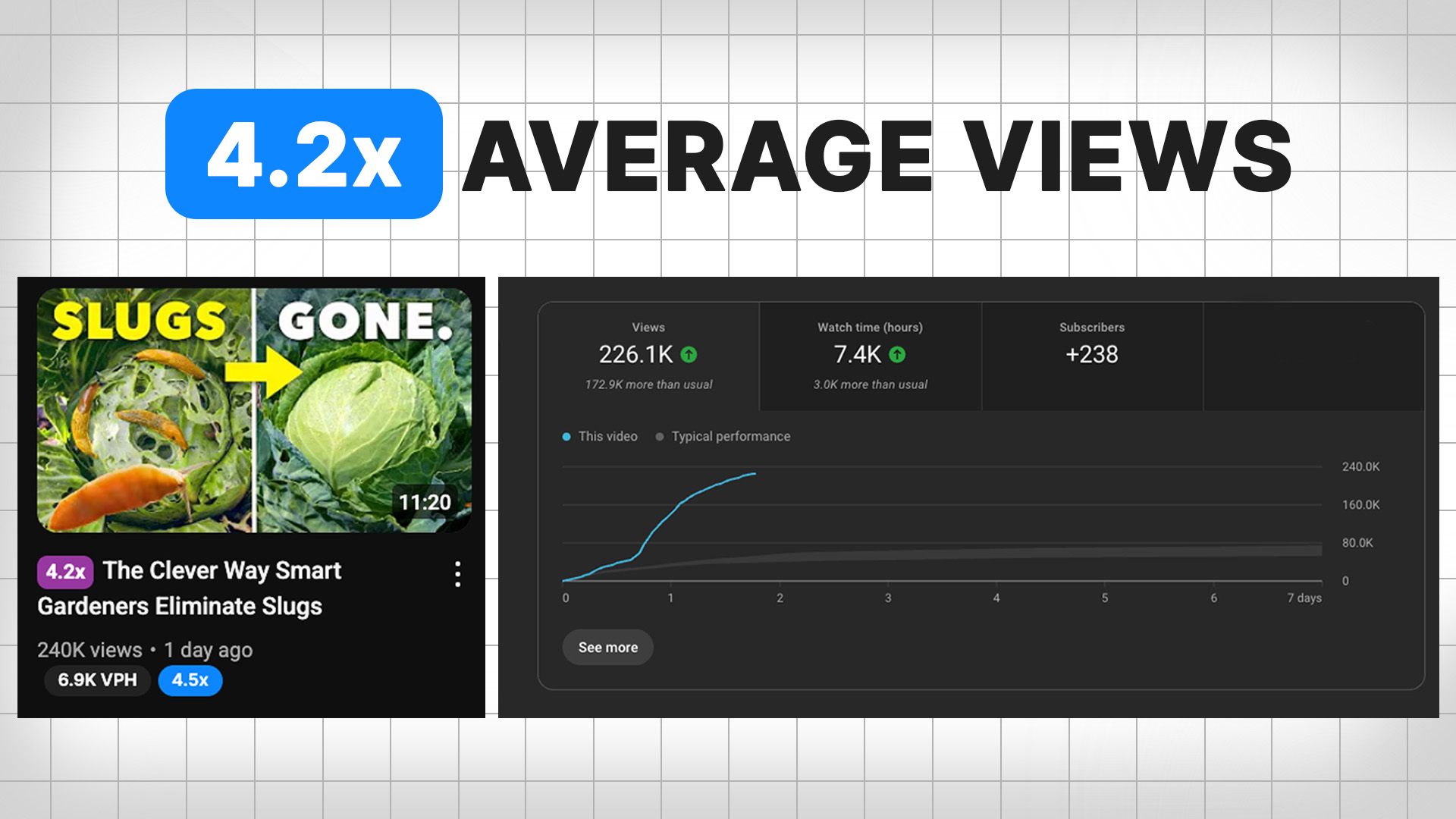
Ben from GrowVeg came to us with an idea for a video about plastic pots. His plan was a list along the lines of 10 hacks for plastic pots in the garden.
The advice was useful, but that title would mainly attract experienced gardeners who already cared about plastic pots. It gave beginners and casual viewers little reason to click.
I suggested The Clever Reason Smart Gardeners Hoard Plastic Pots.
“Clever” makes you wonder what the reason is, but the real work is done by identity. “Smart gardeners” is a group people either believe they are already in or want to be in, and the title quietly tests both.
If you have gardened for years and you throw your pots away, it suggests the smart ones know something you do not, which stings enough to click. If you are new, it shows you the kind of gardener you want to become.
The thumbnail said DON'T THROW, with Ben stood behind a mountain of pots.
The video was still about plastic pots, but it was no longer only for people already looking for plastic-pot hacks. It did around a million views in its first month and has since passed 2.5 million.
Then the shape kept working.
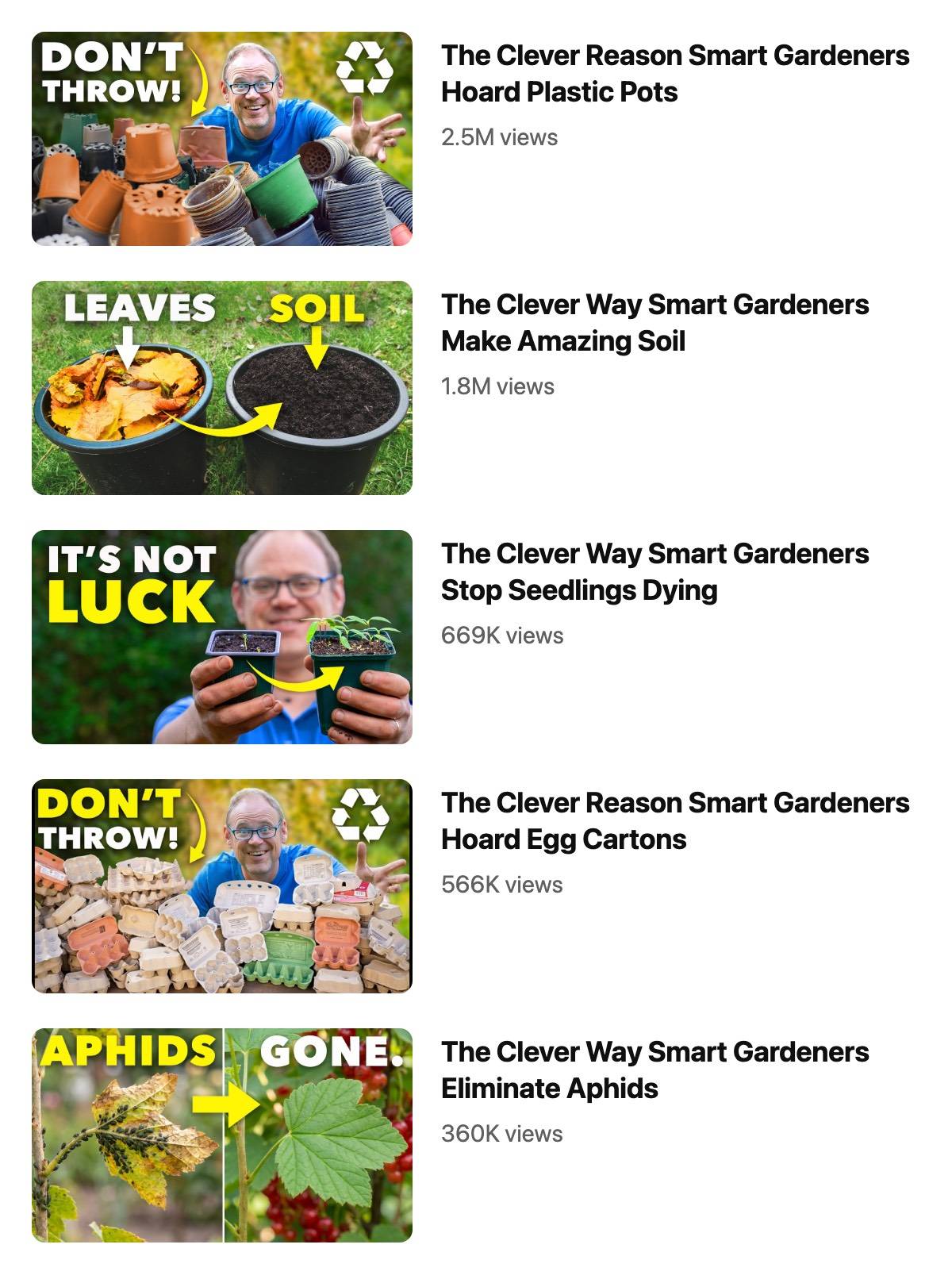
GrowVeg did not grow by talking about anything and everything. It found a Wider entry point into a problem the channel already knew how to solve.
That does not mean every video needs to chase the biggest possible audience. Different videos can do different jobs for the business.
Why the biggest video does not always win
One golf creator I helped ran a channel where uploads typically did a few thousand views. Then one video reached 63,000 views in two days, 35x what his uploads usually did, and booked five coaching calls off the back of it.
Here is the thing to understand. Depth, Core and Wider describe how many people in your world could care about the video. They do not tell you how many views you will get, because that depends on how big your channel already is.
GrowVeg's wide swing did a million views in its first month. This golf creator's breakout did 63,000 in two days. Both were wide for the channel that made them, and both were huge for the business behind them.
So that one video did two jobs at once, it reached new people and it filled his calendar.
Another creator I helped went the other way. He made a Depth video breaking down one specific creator's funnel, which is about as narrow as a video gets. It did around 2,000 views, and it brought him a paying consulting client within 12 days.
The bigger audience did not automatically win. The smaller audience did not automatically win either.
Each video succeeded at a different job.
The same-person test
Whatever dial setting a video sits at, it still has to pass what I call the same-person test.
One person should be able to watch the video, click the thing you link them to, and end up at your offer, with every step solving the same problem in their life.
Most channels screw this up without realising it, as their video pulls in one type of viewer, the free lead magnet in the description was made for somebody slightly different, and the offer behind it was built for somebody else again. This is where the attention you're getting leaks at every handover from video to sale.
Two quick checks make this real.
First, look at which videos actually result in people clicking the link in your description and turning into booked calls or sales. I've seen videos with minuscule views make twice the money of videos with far bigger numbers, and the only way you ever find that out is if you track your link clicks.
Second, watch your returning viewers. YouTube shows you these in the audience tab, split into new, casual and regular viewers. A Depth video will rarely be your most viewed upload, and it was never meant to be. You see it working when your regular viewer count grows, because the right people are coming back, and the people who come back are the people who buy.
Get these two things right and every setting on the dial gets more valuable, because every video, big or small, now feeds the same path to a sale.
Do not turn this into another content ratio
The tempting move is to turn the TAM Dial into a neat monthly calendar.
Maybe three Core videos a month, one Depth video, then a Wider swing every six weeks, and suddenly it feels like the strategy is handled.
That would be easy to teach and dangerous to follow.
A ratio decides what job your next video does before the idea even exists. It should be the other way round.
A chef adjusts the seasoning to the dish in front of them. They do not add chilli because last week's plate was mild.
You do the same thing by reading what the business needs right now. Say your Depth videos reliably bring in booked calls, and your calendar is already full for the next six weeks. Pouring more fuel on that fire does nothing, because you cannot serve the people it brings you.
That is the month to go wider, point the video at a lead magnet instead of a call, and build the list you will email when you have space again. Empty calendar, and the answer flips straight back to Depth.
This is also why you cannot just find the setting that gets you buyers and hammer it forever. Depth videos convert well because they reach people who already know they have the problem, and in any niche that group is small.
Keep fishing the same pond and eventually the leads dry up, not because your videos got worse but because you already reached everyone who was ready. Wider videos put new people in the pond.
Your next video still has to be a strong idea, because a weak one stays weak whatever setting you put it on.
A video only your regulars would watch is not automatically a Depth video. Depth means a narrow problem solved properly. If there is no clear promise in it, the label just gives a weak idea somewhere to hide.
Going after beginners is not automatically Wider either. Wider means reaching more of the right market, not swapping to an easier audience.
Get the idea right first. Then the dial tells you what job it is doing and how far it should travel.
How to use the TAM Dial on your next four videos
Start with the ideas you already believe in, the ones you would be glad to publish whatever the dial says.
Then run this five-step check.
1. Protect the right market
Picture the people this video would bring in. Would you be glad to have them watching your channel in six months?
You can go as broad as you like, so long as the people you pull in are still people you could help.
2. Label the intended setting
Is this video designed for Depth, Core, or Wider reach?
You are only naming what the video is there to do. A bigger possible audience never makes one idea better than another.
3. Lock the package before committing
Write the title and sketch the thumbnail before you film.
If the packaging cannot make the intended viewer recognise the problem and want the result, the idea is not ready, and it may need a different angle.
4. Sense-check the next four
Look at your four labels together. Are they all the same setting?
If all four are Depth videos, nobody new finds you. If all four are Wider, nobody sticks around. If you chose that on purpose, fine. If it happened without you noticing, swap one out, but only for an idea that is just as strong.
5. Give each video a job and a next step
Write down what you expect the video to do. Reach more new viewers? Bring regular viewers back? Generate clicks or leads? Then check back at 30 days and see whether you were right.
Do that enough times and you stop guessing. You start to see which kinds of ideas bring in the right viewers, and which of those viewers turn into buyers.
Then decide the one thing you want them to do after watching, and check it passes the same-person test, so whoever the video pulls in ends up somewhere built for them.
Review the result without panicking
A while back I got talking to someone on Alex Hormozi's content team, and they told me Alex pushed them to review every video's performance inside a 30-day window.
The reason he cares is speed. It would be great to have an evergreen video that brings in 10,000 leads over three years. You know what's better? 10,000 leads in the first 30 days.
Yes, a video can go quiet for six months and then take off, and a slow burner can bring in leads for years. Both are lovely when they happen. Neither is something you can predict or repeat, so neither is something you can get better at.
What you can get better at is which ideas, titles and thumbnails bring the most of the right people into your business in the first 30 days. That is the part you control, so that is the part worth reviewing.
One thing to be fair about while you do it. You still review everything at 30 days, but a Wider video and a Depth video will never put up the same numbers, so do not hold a video to a job you never gave it.
None of this means rebuilding your strategy every 30 days.
One upload mixes together the idea, the title, the thumbnail, the hook and the video itself. A poor result can come from any one of them.
So log the lesson from each video, and only change the system when you see the same thing happen across a few videos. One upload having a bad month is not a pattern.
That is how the dial becomes something you actually use.
You stop asking, “Should I chase views or buyers?”
You start asking, “How far can this idea travel inside the right market, and what do I need it to do for the business right now?”
Your action steps for this week
- Get your ten strongest video ideas into one place.
- Cut anything that would pull in a market you do not want to own.
- Label your next four as Depth, Core or Wider, then check they are not all doing the same job by accident.
Every upload should earn its place, and you should know what job it is there to do before you film it.
Jamie
P.S. Reply with your last four video titles and I'll tell you which setting each one is on.

Put these ideas into practice.
Get The Million-View Blueprint, my free five-day email course to help you make better YouTube videos.
You can read all my previous newsletters here →
Keep reading
A weekly dose of The Creator Stream, where we learn to craft irresistible video ideas and supercharge your titles & thumbnails! Join over 1,750 Creators!